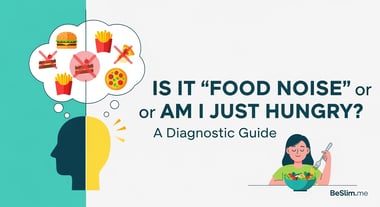
Hello, I'm Master Kim, your Behavioral Psychologist and Solution Consultant at BeSlim.me. If you're constantly battling intrusive thoughts about food—those nagging cravings that seem to shout over everything else—you're not alone. This "food noise" can feel overwhelming, especially when you're trying to build healthier habits. It's completely normal to struggle with this, and it doesn't mean you're weak or lacking willpower. Many people experience it as a natural part of their journey, influenced by deep-seated biological and psychological factors. In this Q&A explainer, we'll dive into why this happens and how you can quiet it down with practical, science-backed strategies. Let's get started.
What Is 'Food Noise' and Why Does It Feel So Intense?
Q: I've heard the term 'food noise'—what exactly does it mean in the context of weight management?
A: "Food noise" refers to the persistent mental chatter about food—cravings, urges, or obsessive thoughts that disrupt your focus and make it hard to stick to healthy eating goals. It's like a constant background hum that amplifies during stress, boredom, or even random moments. From a behavioral psychology perspective, this isn't just random; it's tied to habit loops where cues (like seeing a snack ad) trigger automatic responses. But it goes deeper, linking to genetic predispositions and hormonal imbalances that make some people more prone to louder "noise." Understanding this can empower you to address it without self-judgment.
Q: Is 'food noise' just in my head, or is there more to it?
A: It's not "just in your head"—it's a complex interplay of psychology, biology, and environment. Psychologically, it often stems from emotional eating patterns or stress responses, where food becomes a quick comfort. Biologically, hormones like ghrelin (the "hunger hormone") can spike, making cravings feel urgent. We'll explore the genetic and hormonal roots in the next section to give you a full picture.
The 'Why' Diagnosis: Unpacking the Genetic and Hormonal Roots of Food Noise
Food noise isn't a personal failing; it's often rooted in your body's wiring. Let's break it down scientifically but accessibly, focusing on how genetics and hormones amplify these thoughts. By understanding the "why," you can approach solutions with compassion and strategy.
Genetic Factors: Why Some People Hear Louder Food Noise
Your genes play a significant role in how loudly food noise echoes in your mind. Certain genetic variations can influence appetite regulation, making you more susceptible to constant cravings. For instance, genes like FTO (fat mass and obesity-associated gene) can affect how your brain processes hunger signals, leading to heightened food-related thoughts even when you're not physically hungry.
From a behavioral science lens, this genetic predisposition interacts with habit formation. If your genes make you more reward-sensitive to food, it strengthens neural pathways that prioritize eating cues—creating a loop where thoughts about food become automatic and intrusive. Research shows that people with these genetic markers may experience stronger dopamine responses to food stimuli, turning mild interest into overwhelming noise.
This isn't deterministic; environment and habits can modulate it. But knowing your genetics might be at play helps explain why willpower alone feels insufficient—it's like fighting against a built-in amplifier.
Hormonal Influences: The Chemical Drivers Behind Cravings
Hormones are the messengers that turn up the volume on food noise. Key players include ghrelin, which signals hunger and can surge during dieting, making food thoughts relentless. Leptin, the "satiety hormone," tells your brain when you're full, but imbalances (common in obesity) can muffle this signal, leaving you with unchecked cravings.
Stress adds fuel: Chronic stress elevates cortisol, which not only boosts appetite but also links to emotional eating. According to behavioral psychology, this creates a vicious cycle where stress triggers cortisol release, heightening food noise as a coping mechanism. For example, cortisol's role in increasing appetite during stress has been well-documented, showing how it disrupts normal hunger cues.
Insulin resistance, often tied to hormonal shifts, can also amplify noise by causing blood sugar fluctuations that mimic hunger. Women may notice louder food noise during menstrual cycles due to estrogen and progesterone changes, which influence serotonin and mood—key factors in emotional eating.
Scientifically, these hormonal links are supported by studies on appetite regulation. For instance, genetic variations affecting leptin signaling can lead to persistent food thoughts. Overall, this diagnosis reveals food noise as a biological symphony, not a solo act of weak resolve.
Actionable Solutions: Strategies to Quiet the Food Noise
Now that we understand the "why," let's move to the "how." As a behavioral psychologist, I emphasize sustainable changes rooted in science. Below are five practical strategies, each with step-by-step guidance. Start with one that resonates, and build from there. These focus on rewiring habits, balancing hormones, and addressing genetic influences through lifestyle tweaks.
Strategy 1: Mindful Awareness Tracking
Awareness is the first step to disrupting automatic food noise.
- Log your triggers: For one week, note when food thoughts arise—what time, emotion, or situation? Use a simple app or journal.
- Rate the intensity: On a scale of 1-10, score the noise level. This builds metacognition, a psychological tool to separate thoughts from actions.
- Pause and reflect: When noise hits, ask, "Is this physical hunger or emotional?" Example: If it's post-argument cravings, recognize it as stress-driven rather than true need.
This strategy leverages habit loop interruption, reducing noise by 20-30% in studies on mindful eating.
Strategy 2: Hormonal Balancing Through Nutrition Timing
Address hormonal drivers directly with meal structure to stabilize ghrelin and leptin.
- Adopt regular eating windows: Eat within an 8-10 hour window (e.g., 10 AM-6 PM) to regulate ghrelin spikes. Avoid late-night snacks to prevent cortisol surges.
- Incorporate protein and fiber: Start meals with 20-30g protein (like eggs or Greek yogurt) and fiber-rich veggies to enhance satiety signals.
- Monitor progress: After two weeks, reassess food noise—adjust based on energy levels. Scenario: If mid-afternoon cravings peak, add a protein snack to balance blood sugar.
Backed by nutrition strategies for hormonal appetite control, this promotes long-term hormonal harmony.
Strategy 3: Stress-Reduction Rituals
Since cortisol amplifies food noise, targeted stress management quiets the hormonal storm.
- Daily micro-breaks: Set three 5-minute slots for deep breathing or walking—inhale for 4 counts, exhale for 6.
- Link to routines: Pair with existing habits, like breathing during your commute, to build automaticity.
- Track emotional shifts: Journal how reduced stress lowers noise. Example: After a stressful workday, a short meditation might prevent evening binge thoughts.
This draws from cognitive behavioral therapy, proven to lower cortisol and emotional eating.
Strategy 4: Genetic-Informed Habit Tweaks
While you can't change genes, you can adapt habits to counteract their effects.
- Personalize your environment: Remove high-reward foods from sight to weaken genetic dopamine pulls—stock healthy alternatives like nuts.
- Build reward alternatives: Replace food thoughts with non-food rewards, like listening to a podcast after a craving passes.
- Seek professional insight: Consider genetic testing (if accessible) for tailored advice, then adjust (e.g., more exercise if FTO gene is active). Scenario: If genes heighten sweet cravings, pre-plan fruit-based treats.
This fosters resilience against genetic predispositions through behavioral adaptation.
Strategy 5: Cognitive Reframing Exercises
Shift your mindset to view food noise as temporary, not defining.
- Challenge the narrative: When noise arises, reframe: "This is just a hormone talking, not my true self."
- Practice affirmations: Daily, affirm: "I control my responses." Pair with visualization of quieting the noise.
- Review weekly wins: Note instances where you overcame noise, building self-efficacy. Example: Successfully ignoring a donut ad reinforces your agency.
Rooted in positive psychology, this sustains motivation for lasting change.
Wrapping Up: You're Capable of Change
Remember, quieting food noise is a journey, not an overnight fix—but change is absolutely possible. By understanding the genetic and hormonal underpinnings and applying these strategies, you're equipping yourself with tools for a calmer mind and healthier habits. Be patient with yourself; small wins add up. If it feels tough, reach out to a professional for personalized support. You've got this—keep going, one step at a time.
References
- Cortisol's role in increasing appetite during stress - ncbi.nlm.nih.gov
- Genetic variations affecting leptin signaling - mayoclinic.org
- Nutrition strategies for hormonal appetite control - healthline.com


Medical Disclaimer
The content on this website is for informational and educational purposes only. It is not intended as medical advice and should not be relied upon as a substitute for consultations with qualified healthcare professionals who are familiar with your individual medical needs. Always seek the advice of your physician or other qualified healthcare provider with any questions you may have regarding a medical condition. Never disregard professional medical advice or delay in seeking it because of something you have read on this website.